

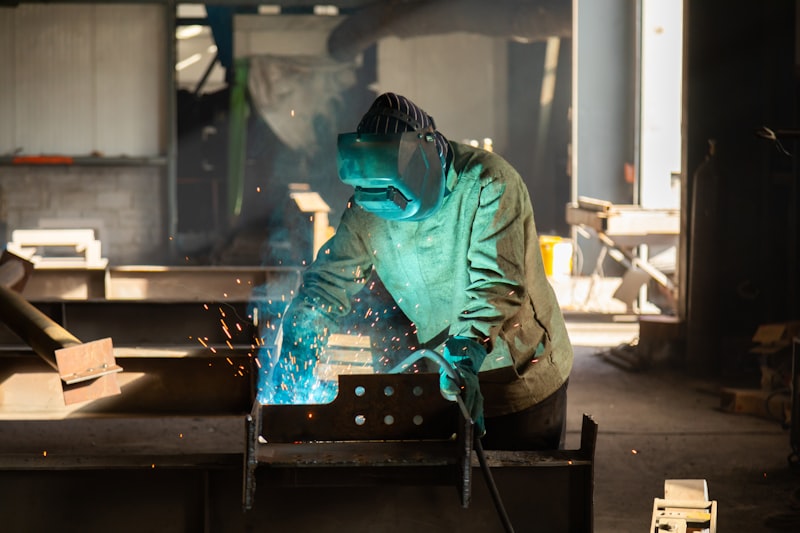
A technical guide, backed by AWS D1.1, to welding types used in steel construction and methods to ensure their quality.
Common Welding Types Used in Construction
Shielded metal arc welding (SMAW) is the most common due to its simplicity and flexibility across different work sites, while gas metal arc welding (MIG/MAG or GMAW) is used on in-house production lines for its speed and high precision on repeated pieces. TIG welding (GTAW) offers the highest precision and cleanest appearance but is slower and more costly, so it's usually reserved for critical joints or exposed finishes that need a clean look without metal spatter.
Welder Qualification and Documented Welding Procedures (WPS)
AWS D1.1 requires every welder to hold a valid qualification certificate specific to the welding process, position, and metal used, not a generic, unspecified certificate. Each welder must also work per a documented Welding Procedure Specification defining current, voltage, welding speed, and electrode type for each joint type, and this documentation isn't a formality — it's an essential reference in any later weld quality investigation.
Visual Inspection: The First Line of Defense
Before any advanced testing, a Certified Welding Inspector performs a detailed visual check on every weld to confirm there are no visible cracks, excessive porosity, insufficient penetration into the base metal, or irregular metal spatter. This relatively simple check catches a large share of common welding defects without needing specialized equipment and is a mandatory step before any additional testing under most approved welding codes.
Non-Destructive Testing and When It's Required
For structurally critical joints, non-destructive tests such as ultrasonic testing (UT) or radiography (RT) are used to detect internal defects invisible to the naked eye, like fine cracks or voids within the weld body. The project's technical specification determines the percentage of welds requiring this testing, and that percentage usually rises for elements carrying higher loads or located in areas difficult to access for future maintenance.
Questions Worth Asking Your Fabrication Contractor
Always ask about the welders' qualifications and their certification against approved codes, confirm there's a documentation record for every critical weld including the welder's name, date, and inspection result, and request to see the non-destructive testing report, if applicable, before final handover. These documents aren't just formalities — they're an important reference should you later need any maintenance or modification work on the structure, or if an insurer or licensing body requests proof of execution quality.