
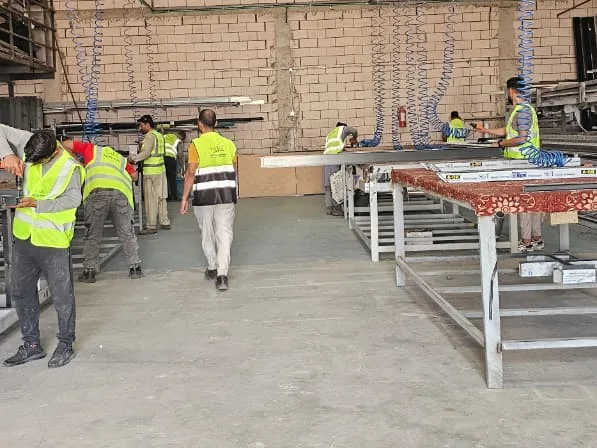
An explanation of the importance of applying structural silicone inside a factory environment with regulated humidity and temperature to ensure efficient load transfer.
Why Applying Structural Silicone on Open Sites is Strictly Prohibited
Structural silicone is highly sensitive to surrounding atmospheric conditions during curing. The presence of dust particles or high ambient humidity on unprotected aluminum substrates prevents complete bonding, which can cause future glass delamination and failure, limiting this process entirely to enclosed factory lines.
Temperature and Humidity Control Criteria for Cleanrooms
Dedicated cleanrooms are allocated for silicone application and curing (Glazing Cleanrooms), maintaining a constant temperature range between 22°C and 25°C, and a relative humidity level not exceeding 50% to ensure optimal chemical reaction and uniform curing of the two-part sealant.
Checking Mix Quality Steps and the Butterfly Test
When operating with two-part silicone (base and catalyst), the butterfly test and snap time test are performed at the beginning of each production shift to verify complete homogenization and ensure the absence of air bubbles or white streaks that indicate poor hydraulic injection mix efficiency.
Destructive and Adhesion Validation Testing (Deglazing & Peel)
The factory goes beyond visual checks; random samples are cut from finished frames to undergo peel tests and complete destructive deglazing tests to verify that the failure mode is cohesive rather than adhesive, ensuring the highest level of structural integrity for the facade system.